The Alternative Pope Project I initiated in 2015 analyzes twentieth and twenty-first-century papal claimants. My focus is on persons who have claimed that they, not the vastly more recognized Roman pontiff, are the Catholic Church’s leader. For example, I don’t include the leaders of the Coptic Church, often called popes, as they do not claim to be successors of St. Peter. Neither do I include the Caodaist popes. Caodaism is a Vietnamese religion led by a pontiff and a college of cardinals. Though Catholic practices influence Caodaism, it is closer to Buddhist, Daoist, and Western Spiritist teachings.
Reformer Jean Calvin and Evangelist Billy Graham have sometimes more or less ironically been called the Protestant Pope, but of course, they did refer to themselves as such. However, leaders of a few groups of Protestant origin in the broadest sense of the word have declared themselves popes. One example is Guyanese Philbert London, televangelist and the leader of the Beacon Ministries and the House of Majesty, an independent Christian community influenced by prosperity theology. He claimed that God elected him pope and was publicly installed in 2016, taking Emanuel as his papal name. Another example is South African Tsietsi Makiti, leader of the Gabola Church.
Pope Tsietsi Daniel Makiti was born in 1965. He had a background in the Old Apostolic Church, but in mid-2017, he founded an entirely different religious organization, the Gabola Church, based in Orange Farm, close to Johannesburg. Initially, Makiti became a bishop, then an archbishop, and in 2018, less than a year after the foundation, he was installed as the pope.
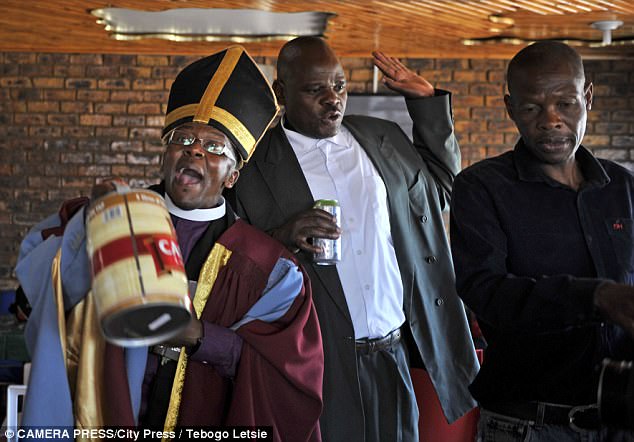
The word “gabola” originates from the Tswana language and relates to drinking. Indeed, the consumption of alcohol is a central feature in the church’s teachings and rituals, and they worship in bars. Initially, church services were held at Freddy’s Tavern in Orange Farm. An essential element of the Gabola Sunday worship is the blessing of alcohol. However, blessed alcoholic beverages are not consumed as a kind of communion at a specific moment; drinking is an integrated part of the whole service. Both clergy and laypeople drink as a part of the celebration.
The consumption of alcohol is seen as an essential means to interact with God. In an interview, Makiti states, “Our Church Constitution requires that we have alcohol when we worship.” Consuming alcohol is necessary for attaining contact with “the Holy Spirit and the ancestors” and for prayers to be efficient.
According to Gabola teachings, happiness entered the world when Jesus transformed water into wine at the Wedding at Cana (John 2:1-11). In the Gospel of John, the miracle initiates Jesus’ public ministry and is a sign of his divine power. To Gabolas, the story is paramount and an example to emulate. According to them, Jesus did not only transform water into wine. He prayed that it would “stimulate the bodies” of the faithful. Through the blessing of drinks, the demons that can make alcohol harmful are cast out. Thus, the Gabola church claims that clergy and laypeople only get drunk “in a nice way.” Their sacred inebriation does not lead to abuse, violence, or accidents but opens up for interaction with God, causing happiness and improving social relations.
Baptism is the ritual that constitutes the conversion and rebirth of an individual and is the church’s initiation ritual. In the Gabola Church, the baptismal forms vary. It can be conducted by the priest pouring people’s “own choice of alcohol.” over their heads or just holding a bottle on their heads. Alternatively, the ritual involves the baptismal candidate drinking an alcoholic beverage that a priest or bishop has blessed. Drinks used in baptisms and other rituals include Castle beer, whiskey, and cider, and the word “Amen” is often replaced by “Amstel,” referring to the famous beer brand.

The basic Gabola missionary strategy is establishing congregations in bars and taverns, simultaneously making their owners (male and female), priests, or bishops. In ordination and consecration ceremonies, more exclusive types of alcohol are used than in ordinary church services. When tavern owners are ordained if baptized, their customers become congregants, and on Sundays, religious services take place in their bars.
By late 2017, the Gabola Church opened new branches in Bloemfontein and Evaton. After this relatively slow establishing phase, the church grew exponentially, and by mid-2018, they claimed about a hundred branches in South Africa, i.e., taverns transformed into temples. At this time, the organization was registered under the name Gabola Church International Ministries.
An essential part of Makiti’s message is that God sent him as a prophet to “be the voice of the voiceless.” The Gabola Church is a church for drinkers and a church of the people. The goal is to reach groups treated as outcasts by many other churches, as they ban the use of alcohol. However, he accuses church leaders who demand teetotalism from the congregants of being hypocrites as they often drink themselves. And teetotalism is against God’s will, as Jesus started his ministry with the wine miracle.
Through transforming taverns into churches and converting people to the Gabola faith, Makiti claims that many social problems are solved, e.g., the violence rate drops and low-income families’ conditions improve. One crucial reason for improved living conditions was that people no longer donated their money to churches Makiti considers predatory. His main targets are the evangelical charismatic megachurches, apostles, and prophets who demand tithes and other kinds of enforced donations.
According to Makiti, the Gabola church does not ask for money from congregants. All revenues from buying alcohol at reasonable prices while attending services are used for buying new alcoholic beverages that he claims benefit the congregation spiritually. Along with this line of argumentation, all proceeds go back to the congregants and finance the medium of divine interaction, i.e., alcoholic drinks. Makita also claimed many members had found employment by converting to the Gabola church.
A typical invitation to a church service is found on its official Facebook page, explaining the church’s mission and beliefs. In the invitation, the church underlines the interaction of religiously and socially transformative aspects of the Gabola ministry.
Please b informed dat dis Saturday Gabola Church Service Will be in Klerksdorp/Matlosana Location @Sister Zulu’s Tavern Ext 22. Launching of Branches, Baptismal of new Members n Ordaining new Tavern Owners as Pastors to take care of God’s Sheep (customers), Combating Crime n Supporting Our Government in meeting it Halfway by converting Taverns into community Holy Places not Criminal Heavens! Your Availability for dat Historic Occasion will be highly Appreciated by Church Leadership n Archbishop Himself. Thank U in advance Our Beloved in God of Gabola Church. Hallelujah-Amen (7 December 2017).
In March 2018, Tsietsi Makiti was installed as the Pope. From available source material, it is not clear whether he claimed that the establishment of the papacy was an answer to a divine message. At that time, the Gabola Church, with some hundred branches, published an invitation to the papal installment, underlining church growth and the prospects for international expansion.
De whole world hereby cordially invited to VMC/E tjanini pub@Evaton-North in Vaal for Ordination Ceremony of Archbishop Tsietsi Daniel Makiti of Gabola Church as First Black African POPE (Mopapa) for his Global Religious Iconic Achievements to date as de Leader n Founder of de Holy Church of God de Creator of Heaven n Earth. Countless Tarverns was converted into churches n de Owners into Pastors, dat gave birth to a crime free communities, countless families can now afford to put bread on de table bcos of its Church theme dat reads: “# church Fees Must Fall” Contless families live at peace with no more Abuses, Countless members r employed n countless Youth r Developed to capacity to mention but few. So Come one come All to b part of de Global Religious History in Making. NB Food n drinks Galore @ reasonable prise Godbless All de Beloved Citizens n congregations Internationally (28 March 2018).
The leadership once again highlights the Gabola church’s transformative role. In other documents, Makiti claims that the church uniquely decolonizes and contextualizes the Christian faith. Makiti informed journalists that he was writing a Bible mainly destined for the Gabola faithful. Counteracting Christians who denounced his church, Makiti stated: “They think that we, as the people of Gabola, undermine their Jesus. Jesus was not in South Africa. He is just arriving now with the Gabola Church.”
In his view, the Christian message had never taken root in South Africa before the foundation of the Gabola church, as it was not made relevant. From the few biblical passages made available to outsiders, the Gabola Gospel is centered on events following the establishment of new branches and teachings about grace and conversion.
Msge of the day reads: Gospel according to Gabola Church for All Nations, 1Evaton North chapter 1 verse1-3 says, therefore, If anyone is in Gabola Church for All Nations, He/She is a new creation. the old has passed away, the new has Come, For by grace you have been saved through faith and this is not by your own doing but it is the Gift of God for All Magabolas around the World.Stay Blessed Beloved-Pope Makiti (19 November 2018).
With their unorthodox teachings and rituals, in which alcohol plays an essential role, it is not surprising that the established Christian churches denounced Pope Makiti and his growing group of adherents. The South African Council of Churches did not mince matters when describing the Gabola church as a “cult and disgrace to Christianity”; even a sign of “the end of times.”

In November 2018, news circulated on social media that Makiti died from an alcohol-related disease. That was not the case; counteracting the false reports, the church leadership further explained their view on alcohol and its use within the church.
The One & Only Progressive Pope in the world would like to calm all alcohol drinkers after nasty post has been doing the rounds in social media that he has past away. In Gabola Church, we encourage responsible drinking and there is no way he can die because of alcohol abuse as he leads by example. He wishes all his nemises and distractors very long life just so they live and experience the success of all drinkers in the world. Amstel!!! (12 November 2018.)
In early 2019, Makiti launched a political party, the Gabola Church United National Front Party, focused on fighting crime and corruption, including harsher penalties and re-establishing capital punishment.
The Covid 19 pandemic hit South Africa hard. As a response to the spread of the virus, the state authorities enforced curfews, strict lockdowns, and other restrictions for extended periods. As a part of the policy, they also banned the sale of alcohol beginning on 27 March 2020. The government argued that the ban would contribute to social distancing and positively affect health. They stated that the ban would decrease the number of deaths and severe injuries related to alcohol use. These measures would alleviate the hospitals that needed to focus on treating Covid patients.
Though social lockdowns and restrictions on public gatherings affected all kinds of religious entities, the ban on alcohol had a particular effect on the Gabola Church, as drinking was the very center of the Church’s rituals. They stated that without alcohol, there was no true prayer. Still, the Pope informed the media that he constantly prayed and fasted for the ban to be lifted. During the pandemic, the church and some of its adherents released popular music that spread its message, trying to counteract the lack of possibilities to gather.
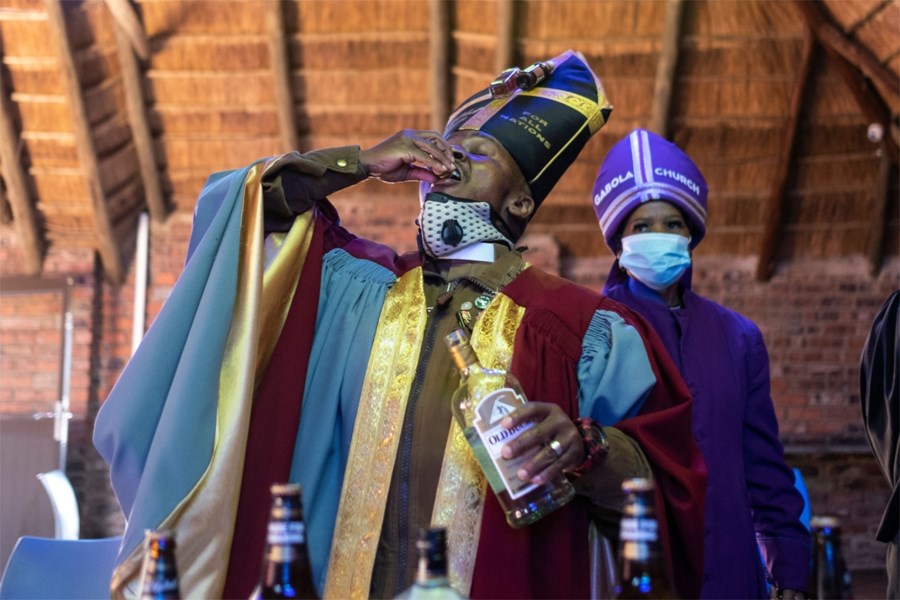
Though initially playing down the gravity of the pandemic, stating that it would primarily affect the rich and not the poor, the Church soon underlined the importance of social distancing and wearing masks but denounced the ban on alcohol. Still, Makiti also thought that God sent the virus to make “self-appointed prophets” realize they had no healing powers. Thus, he applied his general denunciation of charismatic Christian churches to the pandemic. In his view, the church leaders bamboozled their adherents, claiming powers they did not have with the sole purpose of enriching themselves.
In May 2020, the police arrested Makiti, his wife, and a small group of adherents for possessing alcohol and using it at a service at home. Later that year, the Pope’s wife died due to a Covid-related illness.
When the South African ban on alcohol was lifted, drinking in bars and other public places remained restricted. In this situation, the Pope urged the adherents to drink at home before going to church, as only water would be blessed and consumed during the ceremonies, which often were held outdoors. However, he and other members complained that alcohol prices had increased and prayed for a normalization.
In an article published by The Daily Sun in October 2022, Makiti summarized how the pandemic and the restrictions had influenced the church. Before the pandemic, the church had grown exponentially, but it had made things different, as they could not meet or carry out their central rituals. He hoped that the end of the pandemic restriction would contribute to renewed church growth.
References
The Gabola Church’s official Facebook page includes entries between 2017 and early 2021.
https://www.facebook.com/people/Gabola-Church/100076305661930/
The Johannesburg-based Daily Sun newspaper provides the most detailed reporting on the Gabola church. Though other newspapers and sites report on the church, the fundamental source material is articles published in the Daily Sun between 2017 and 2022: on 26 August, 8 November, 13 November, 22 November 2017; 24 August, 6 November 2018; 5 March, 12 August, 2 December, 10 December, 13 December 2019; 20 May, 8 July, 19 August, 24 August 2020; 25 January, 2 February, 11 July, 25 October, 14 December 2021; 4 October 2022.
 Magnus Lundberg
No transubstantiation claim…thankfully.
LikeLike