Ny bok om global kristendom

Ny bok om global kristendom

Religion i gränslandet: Perspektiv på global kristendom. Festskrift till Kajsa Ahlstrand
(Red) Julia Kuhlin, Magnus Lundberg, Anita Yadala Suneson & Johannes Zeiler, Uppsala: Studia Missionalia Svecana, 2026

Global kristendom är ett mångfacetterat och expansivt forskningsfält. Inom detta fält studeras tro och praktik över geografiska, kulturella och konfessionella gränser. Sett ur detta perspektiv är gränslandet inte en perifer zon, utan en central plats där religionen tar form. Här möter historiska lager samtida processer och här omformas uttryck, identiteter och traditioner. Att studera religion i gränslandet är att följa rörelser, förhandlingar och omtolkningar i realtid.

Religion i gränslandet: Perspektiv på global kristendom är en festskrift till Kajsa Ahlstrand, professor i missionsvetenskap/global kristendom vid Uppsala universitet sedan 2006. Få personer inom det nordiska forskningsfältet har som hon betonat vikten av att uppmärksamma och följa dessa rörelser. Hennes arbete har visat att akademisk forskning om global kristendom måste präglas av nyfikenhet, ödmjukhet och dialog, inte minst i mötet med andra religioner, traditioner och erfarenheter. Hon har framhållit att forskaren måste vara lyhörd för det oväntade, för det som inte omedelbart låter sig fångas av etablerade kategorier, och att varje tradition bär spår av andra genom historiska och samtida kontaktytor.

Continue reading “Ny bok om global kristendom”
Legio Maria: Early History

Legio Maria: Early History

Beyond a doubt, Legio Maria — now formally Legio Maria of Africa Church Mission — founded in Kenya around 1962 is the largest of the groups with an alternative pope. While it is difficult to compute membership, the Kenyan government estimates that there are as many as 3 or even 4 million Legios in Kenya alone. Legio Maria should not be confused with the Roman Catholic lay organisation, Legion of Mary, also known as Legio Mariae. Still, many of the founding members of the Kenyan Legio had backgrounds in the Legion of Mary and viewed it as a precursor to their movement.

Established in the Nyanza province in the early 1960s, Legio Maria soon spread to other parts of the country and abroad, both within Africa and, to a lesser extent, overseas. Legio Maria has its roots in Roman Catholicism but, following the metropolitan model, has developed its own ecclesiastical hierarchy, including a pope. The Legios use the traditional Latin Order of the Mass in a pre-1962 version, but also have a clear focus on charismatic gifts available to ordinary believers, not only to holders of formal offices.

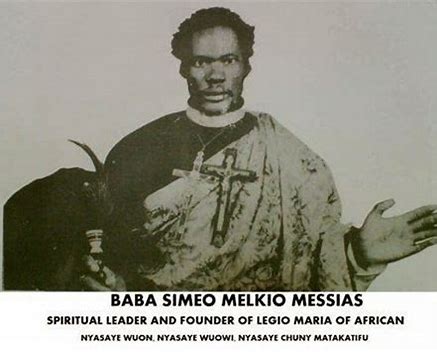
Legios believe that the founder, Simeo Ondeto (1926?–1991), was divine. He was the Second Coming of Christ. Therefore, the faithful refer to him as Baba Messias, Baba Simeo Melkio, and similar varieties of that name, ‘Baba’ meaning Father. They also revere Mama Maria or Bikira Maria († 1966), originally known as Regina Owitch, whom they see as the Virgin Mary and Baba Messias’s spiritual mother. Because of their supernatural origins, Baba Messias and Mama Maria held unique positions.

Continue reading “Legio Maria: Early History”