Upcoming Conclave: A Successor of Pope Michael Will be Elected

Upcoming Conclave: A Successor of Pope Michael Will be Elected

In February 2023, I wrote a substantial piece on Pope Michael for the World Religions and Spirituality Project. Pope Michael (David Bawden, 1959-2022) was an alternative pope, elected in a small conclave in Kansas in 1990 and for the last decade based in Topeka. He claimed the papacy until his death on 2 August 2022. From the time of his passing away, his group of adherents declared the Holy See vacant and began planning for a new conclave. Until recently, no date was fixed, but in the June 2023 issue of the Vatican in Exile’s newsletter: The Olive Tree the group makes an official announcement on the conclave. It will be held in late July. Surprisingly, the electors will not gather in the United States but in Vienna.

“On Conclave
It’s almost a year ago when His Holiness Pope Michael of happy memory met his Creator. We are dilapidated by his passing away but we are grateful to the Lord for giving him to us. Pope Michael has left us a legacy that is priceless. That is from mere sedevacantism to conclavism. He did not mind the persecution, what matters is the good of the Church. His reputation was maligned yet what matters to him is ” sentire cum ecclesiae ” i.e.thinking with the mind of the Church.

Continue reading “Upcoming Conclave: A Successor of Pope Michael Will be Elected”

Maurice Archieri: The French Vicar of Christ

Maurice Archieri: The French Vicar of Christ

On Pentecost, 5 June 1995, Maurice Archieri (1923–2016), a retired car mechanic living in the Parisian suburb of Le Perreux-sur-Marne, received an intellectual vision where the Holy Ghost made him the Vicar of Christ.  Archieri took the name Pierre II–Peter II–but clarified that he was not the pope.  According to his understanding, John Paul II materially occupied the Holy See.  However, he was not a valid–formal–pope but the leader of a new non-Catholic religion.  Based on private revelations and apocalyptical writings, Archieri claimed that there could be no pope in the current era and that he, as the Vicar of Christ, was the leader of the Catholic remnant in the age of general apostasy.

See the Alternative Pope Project Working Paper “Maurice Archieri (1923-2016): The Vicar of Christ in Le Perreux-sur-Marne”, which also includes a collection of texts written by Pierre II.

New Article on Pope Michael

New Article on Pope Michael

I have recently published a substantial entry (some 30 pages) on Pope Michael which forms part of the important World Religions and Spirituality Project (WRSP), an online resource focused on new and emergent religious groups, edited by Professor David G. Bromley at Virginia Commonwealth University.

David Bawden (1959–2022) was elected Pope Michael I in a 1990 conclave in Kansas.  He was neither the first nor the last man to become an alternative pope during the twentieth century. There have been dozens of others who claimed that they, not the vastly more recognized pope in Rome, are the true leader of the Catholic Church. Generally, they argue that we live in an era of general apostasy and that the modern church, particularly after the Second Vatican Council (1962–1965), has nothing to do with true Catholicism. Several of the latest Roman pontiffs were antipopes and leaders of a new non-Catholic religion. Most alternative popes assert that they were elected through direct heavenly intervention, and David Bawden was the first elected in an alternative conclave. He claimed the pontificate for thirty-two years, leading a small group of followers.

My text is found here

A Newly Discovered Collection of Documents from the New Jerusalem Catholic Church of the Celestial Messenger

A Newly Discovered Collection of Documents from the New Jerusalem Catholic Church of the Celestial Messenger

Almost four years ago, I co-authored the book Giuseppe Maria Abbate: The Italian-American Celestial Messenger with James W. Craig. At that time, we believed that essentially all archival material related to Abbate and his New Jerusalem Catholic Church of the Celestial Messenger had been destroyed in the early 1990s.

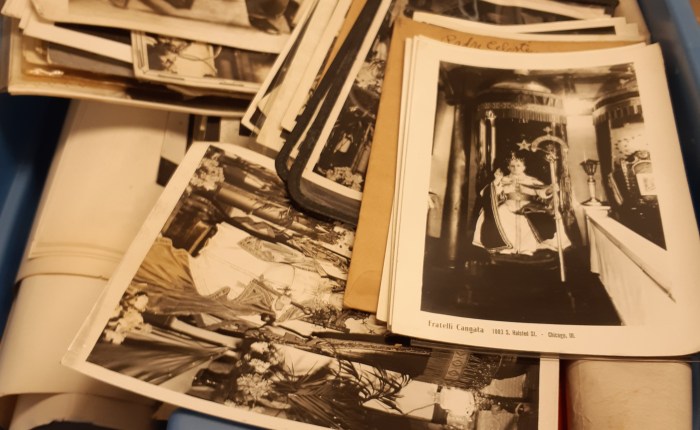
However, a sizable collection, once part of the church archive, has recently appeared. It includes publications, documents, photos, and objects. Not even the official publications, such as the L’Araldo magazine, are found in any research library I know. Thus, the collection contains unique materials and will serve as a basis for further studies on Abbate and his church. Currently, the archive is stored with me, and I’m preparing an article about the foundation and early development of the church. Hopefully, other studies will follow. In the near future, I will publish a selection of reproductions of photos and pictures of objects from the collection on this website. Below, you will find a few images of the collection before I started organizing it.

Continue reading “A Newly Discovered Collection of Documents from the New Jerusalem Catholic Church of the Celestial Messenger”

The Pope of Eddystone, Pennsylvania

The Pope of Eddystone, Pennsylvania

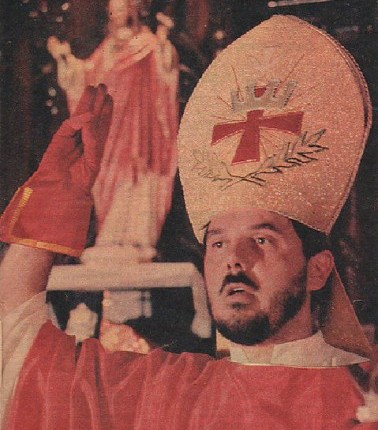
Chester Olszewski from the United States is one of the least known of the modern alternative popes. He was a cradle Catholic who converted to the Episcopalian Church and became a priest. From 1974, he served as a priest in Eddystone, Pennsylvania. In the following year, he became convinced that a statue of the Sacred Heart Christ, owned by a Catholic woman, Anne Poore, bled and bore the stigmata. Olszewski brought the statue to church, where he made it the central devotion.

 Shortly thereafter, Olszewski and Poore claimed to be divinely chosen to restore the traditional Catholic faith; God had converted them to Catholicism. In order to re-establish the true Catholic Church, Olszewski needed to become a bishop and he soon found an independent bishop who provided him with the much sought-after apostolic succession.

On 31 May 1977, Olszewski proclaimed himself Pope Chriszekiel Elias at a ceremony in St. Lukes’s Episcopal Church in Eddystone, alleging that God himself had elected him and provided him with his new name. Later he began to call himself Peter II, the last pope in history.

Here you can read my article on the Pope of Eddystone, Anne Poore, and their church. It’s the first more extensive study on the subject.

Eduardo Dávila – Pope Eduardo I

Eduardo Dávila – Pope Eduardo I

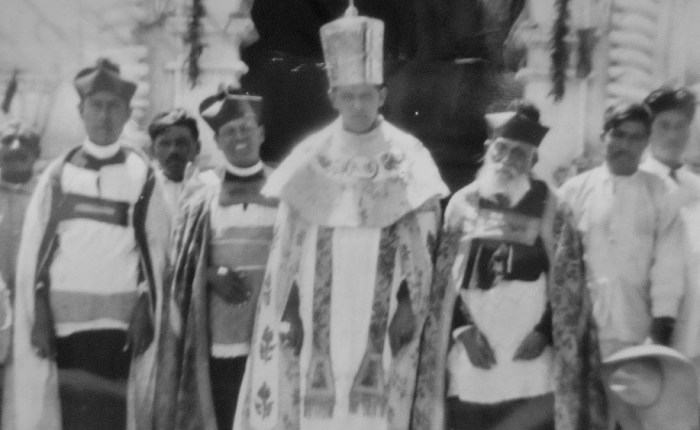
In 1933, Eduardo Dávila Garza (1908?–1985) was elected Eduardo I, ‘Pope and Supreme Pontiff of Mexico and the Americas.’ Still, his plans were grander than that; he would soon replace the Roman pontiff, too, not only rule over the American double continent. Dávila is not an easy person to study. Not only is the source material fragmented, but he also had a well-developed ability to reconstruct his autobiography and fill it with contradictions.

From the late 1920s, Eduardo Dávila was part of the Iglesia Católica Apostolica Mexicana (ICAM; the Mexican Catholic Apostolic Church), founded in 1925 and also called Iglesia Católica Ortodoxa Apostólica Mexicana, which was led by Patriarch José Joquín Pérez Budar. Due to the Mexican government’s enforcement of strict anti-religious laws, the Roman Catholic episcopacy decided to suspend the cult entirely. For three years, between 1926 and 1929, no public Roman Catholic services were held in the republic.

Being pro-governmental and fiercely anti-Roman, ICAM assumed a relatively strong position in indigenous villages in states like Veracruz and Puebla for a few years. However, they were present in Mexico City, too. In the first years of the 1930s, after the Patriarch’s death in 1931, the Church fell apart. At that time, young Eduardo Dávila suddenly appeared on the scene and managed to achieve as the leader of one faction, though his ecclesiastical credentials were questionable. He assumed the Patriarchal office, and in the end, he was elected the Pope.

For a prelimary research report on Eduardo Dávila/Pope Eduardo I

Research Report on the Universal Christian Church of the New Jerusalem

Research Report on the Universal Christian Church of the New Jerusalem

La Chiesa Cristiana Universale della Nuova Gerusalemme–The Universal Christian Church of the New Jerusalem–was founded on October 4, 2015. Three days later, the Assembly of the Faithful elected Samuele Morcia (b. 1972) Supreme Pontiff Samuele. The headquarters of the Church is located in the small town of Gallinaro in the Frosinone province, about 110 kilometres east of Rome.

Of the nearly 2,500 church members most live in the neighbouring regions, but also other parts of Italy, particularly in Sicily, and to some extent abroad. The Universal Christian Church of the New Jerusalem considers itself to be the continuation of the One Holy Catholic Church. They claim that Pope Francis is no true pontiff, but a usurper who has created a new syncretic world religion that has nothing to do with Christianity.

Like many similar cases, the New Jerusalem Church has a background in private revelations. Giuseppina Norcia (1940–2008), Samuele Morcia’s mother-in-law, claimed to receive visions and heavenly messages, both as a child and as an adult. After a series of revelations in 1974, she constructed a small chapel in Gallinaro, La Piccola Culla del Bambino Gesù–the Little Cradle of Baby Jesus–which soon became a popular pilgrimage site, where many people claimed to be healed.

Here you find my research report on the Church:


New Text on the Apostles of Infinite Love

New Text on the Apostles of Infinite Love

Les Apôtres de L’Amour Infini (the Apostles of Infinite Love) have their centre at the Monastery of Magnificat of the Mother of God in St-Jovite/Mont-Tremblant in the Canadian province of Quebec. Their goal is to preserve the traditional Catholic Deposit of the Faith, supplementing the Roman Catholic Church in an era of almost total apostasy.

For five years, between 1962 and 1967, the Canadian group was part of the Renewed Church led from France by Michel Collin (1905-1974): Pope Clement XV. After that, they became independent, claiming to be the Renewed Church of Jesus Christ, led by Fr. John Gregory (Gregory XVII) until he died in 2011 and then by Fr. Mathurin (Gregory XVIII).

The World Religion and Spirituality Project has published my rather extensive overview of the Apostles’ history. You find the text here

The website of the World Religion and Spirituality Project (WRSP), coordinated by Professor David G. Bromley includes updated entries on a growing number of religious group, not least so-called New Religious Movements.

New Study on Pope Christophe XVIII and La Très Sainte Église de Jésus-Christ, Mission de Banamè in Benin

New Study on Pope Christophe XVIII and La Très Sainte Église de Jésus-Christ, Mission de Banamè in Benin

In 2009 Mathias Vigan was a Roman Catholic parish priest in the village of Banamè in south-eastern Benin. In January that year, he met a young woman named Vicentia Tadagbé Tchranvoukinni, whom he exorcised. As she went through the deliverance process, she assumed a new name, Parfaite, claiming increasing charismatic powers and wisdom. Soon, she asserted that she God the Holy Spirit–Dieu Saint-Esprit–also referring to herself as Daagbo.

Daagbo’s End Time mission to extirpate “witchcraft” and crush the Devil’s power; to purify and renew the Catholic Church; and to create peace and prosperity, saving humanity from eternal damnation. By her side was another young woman, Nicole Soglo, whom Daagbo asserted to be the representative of the Virgin Mary on earth: Nanyé Nicole. Mathias Vigan believed in Daagbo’s claims and took an active part in the mission.

In 2011, Daagbo founded a separate church, currently know as La Très Sainte Église de Jésus-Christ, Mission de Banamè–The Most Holy Church of Jesus Christ, Banamè Mission. But in her view, it was nothing new, but the One True Catholic Church, founded by her son Jesus Christ. Eventually, in late 2012 she made Mathias Vigan pope with the name Christophe XVII, and with time the pope, too, received an increasingly divine status as another Jesus.

My research report on La Très Sainte Église de Jésus-Christ, Mission de Banamè is found here.

The Slavic Pope? Jan Maria Michał Kowalski and the Mariavites

The Slavic Pope?  Jan Maria Michał Kowalski and the Mariavites

As far as we know, Archbishop Ján Maria Michał Kowalski (1871–1942), the longtime leader of the Polish (Old) Catholic Mariavite Church claimed much spiritual power, even a kind of Messiah-status, but that he never explicitly claim the papacy. Still, bishops in the Mariavite core group, at least from the mid-1920s, asserted that the Roman pontiff was not the true pope anymore, that the Holy See had moved from Rome to the Mariavite centre in Plock, and that Kowalski was the long-awaited ‘Slavic Pope’, that Polish nationalist authors wrote about: a liberator and a benevolent religious leader.

The founder of the Mariavites was Sister Feliksa Maria Franciszka Kozlowska (1862–1921), often called Little Mother (Mateczka). She claimed to receive divine revelations–‘understandings’–from 1893 onwards, and the interpretation of them played a significant role in the development of the Mariavite doctrine, both before and after her death. Posthumously many followers believed Little Mother to be divine, and Archbishop Kowalski had an almost sacred status, even during his life. Claiming ‘understandings’, too, he introduced drastic doctrinal changes throughout the 1920s. Still, Kowalski’s autocratic rule and the unorthodox doctrinal development led to a schism in 1935, when only a small minority of the faithful remained with him.

A preliminary version of my text on Kowalski and the Mariavite papacy is found here