In my ongoing Alternative Pope project, I have not devoted much time to one of the larger religious groups of that kind: the Canadian Army of Mary, a.k.a. the Community of the Lady of All Peoples (hereafter, I will only use the term Army of Mary).
When it was founded in the 1970s, the group had official status as a pious association in the Roman Catholic archdiocese of Quebec. However, over the years its teachings became increasingly unorthodox and drew harsher criticism from the official church. Eventually, in 2007, the church authorities excommunicated its adherents.
In this text, I will provide a brief background on the Army of Mary and its teachings, but the main focus will be on the last years (2024–2026), when the movement has split into two factions and two papal claimants emerged.
A Brief History
Some helpful summaries of the Army of Mary’s history and doctrinal development are available. Two of them, written by Peter Jan Margry and Massimo Introvigne, respectively, are available on the World Religions and Spirituality Project website. I draw much of the background from these two texts.
Marie-Paule Giguère (1921–2015) was absolutely central to the Army of Mary’s development. Born in Sainte-Germaine du Lac-Etchemin, Quebec, she married in her early twenties, had five children, but divorced in 1957. From the late 1950s, she claimed to receive increasingly frequent heavenly messages, urging her to start a religious organization.
Based on an apparition, Giguère founded the Army of Mary (L’Armée de Marie) in 1971, partly as a counteraction to Quebecois secularisation (”the quiet revolution”) and the rapid post-conciliar changes in the Catholic Church. Still, the group showed no clear opposition to the Council as such. The archbishop of Quebec gave the Army of Mary official status as a pious association.
In the late 1970s, Giguère began what would become an 18-volume, 6000-page spiritual autobiography, Vie d’Amour, which she concluded in 1993. In the early 1980s, the Army of Mary began constructing their headquarters in Lac-Etchemin, later known as Spiri-Maria, and founded the Community of the Sons and Daughters of Mary, a religious congregation with male and female branches.
The content of her publications, the founding of formal religious congregations, and the construction of a massive headquarters prompted a reaction from the official church. In 1987, the archbishop of Quebec declared the group schismatic. Later, Roman authorities confirmed the ordinary’s decision.
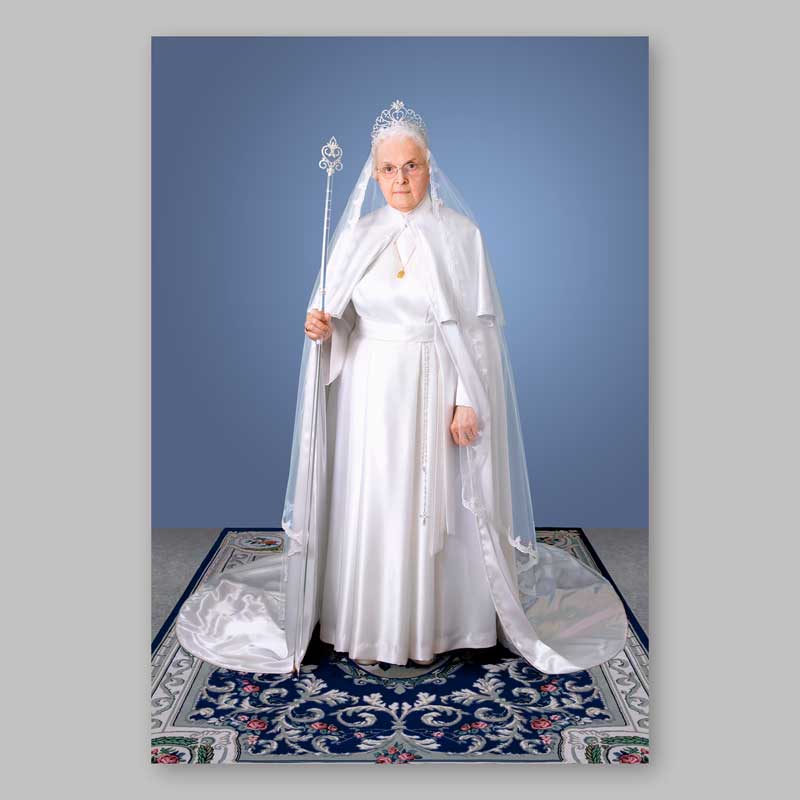
Marie-Paule
From the late 1970s onward, the French apocalyptic author Raoul Auclair (1906-1996) became a leading theologian in the group. Later, Marc Bosquart (b. 1955) became another significant theological author. They were both influential in developing the group’s new theology.
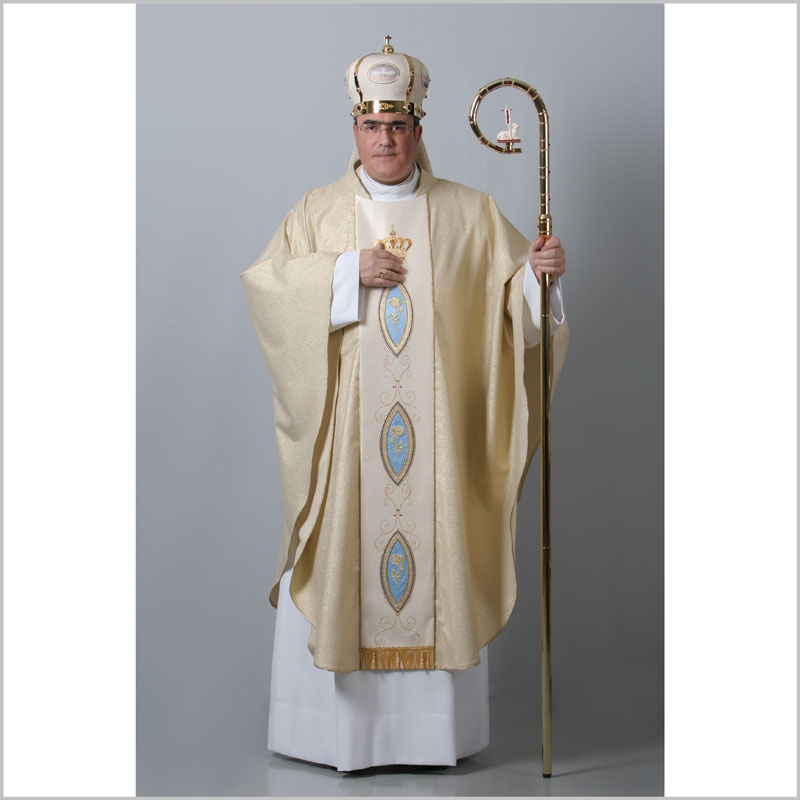
Pope Jean-Pierre
Jean-Pierre Mastropietro, the leader of the Sons of Mary, ordained priests, despite not being consecrated a bishop himself. In 2007, Rome excommunicated the leaders, priests, women religious, and lay members, declaring the group’s teachings heretical.
Mastropietro became Pope Jean-Pierre and leader of the newly established Church of John, considered the true alternative to the rapidly declining Roman Church of Peter. The split with Rome was a fact, and Pope Jean-Pierre canonized people and defined dogmas. One particularly revolutionary new idea was, in the words of Massimo Introvigne, the ”moving from the Christian Trinity to a Quinternity” which added the Virgin Mary and Marie-Paule herself to the Father, Son, and Holy Spirit.” In this new Church, Marc Bosquart was crowned king as Marc-André I.
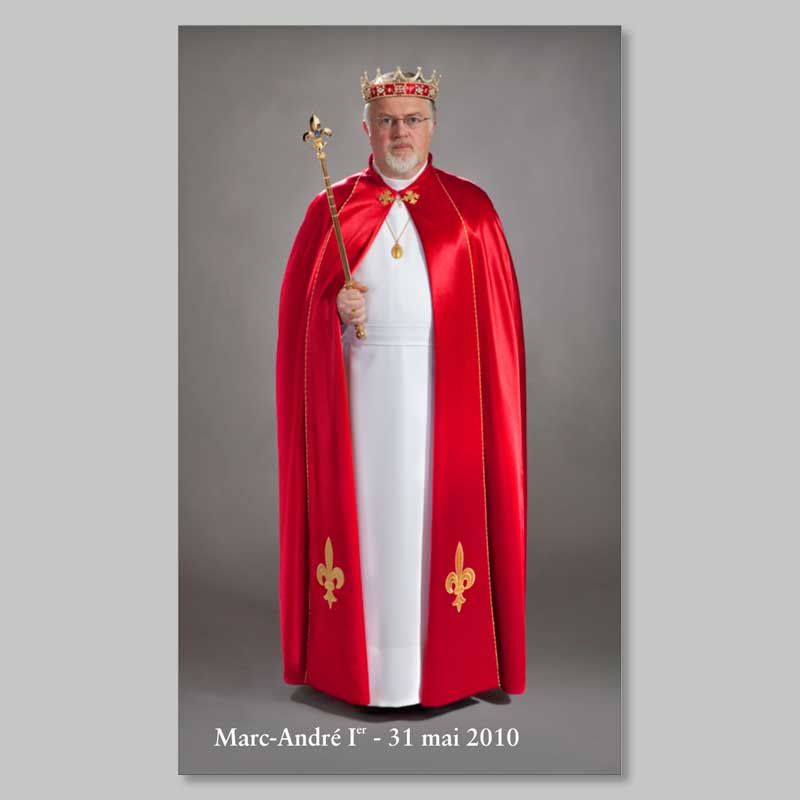
Recent Developments
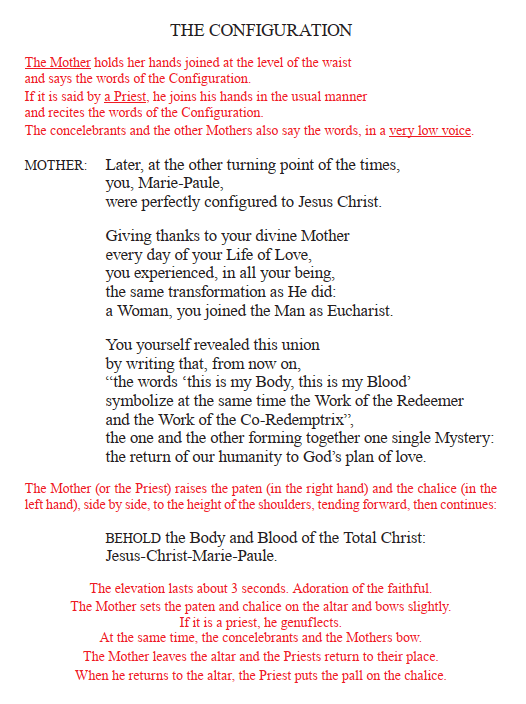
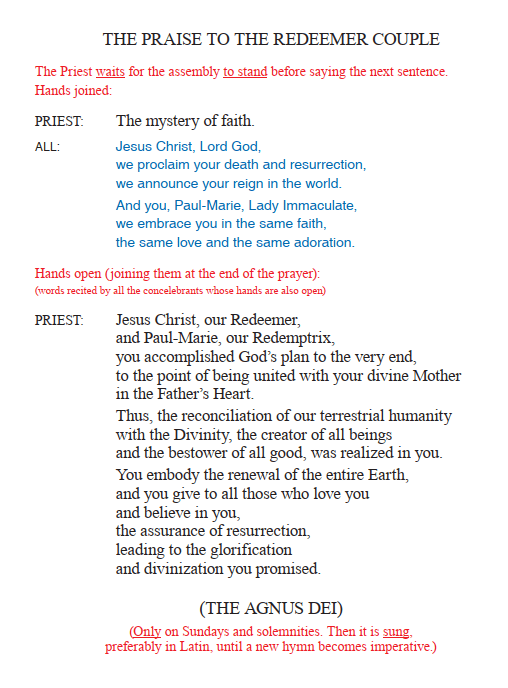
The central status of the Virgin Mary and Marie-Paule also led to the belief that not only Christ but also the Virgin and Marie-Paule were present in the communion, but until recently, the Mass ritual was largely unaltered. Whether and to what extent the Mass liturgies and other liturgical acts should change became a point of discord between the Pope (Mastropietro) and the Church King (Bosquart). In short, the latter wanted much more thorough reforms than the former.
In 2022, Bosquart published the book Un amour infini, in which he laid out a radical change to the Church of John’s liturgy. In his view, the goal was to reflect the dogmatic teachings of the Church more closely–”the new faith of the Kingdom,” as he put it. Pope Jean-Pierre was much more reluctant.
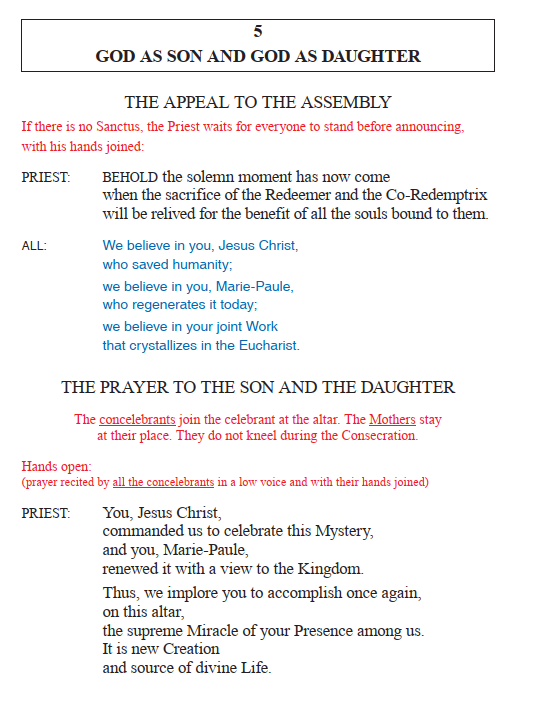
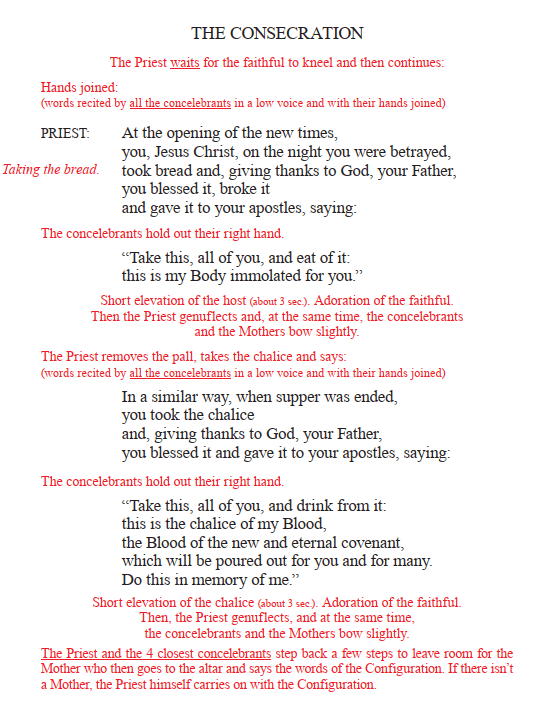
Although the discussions and conflicts between the two factions began earlier, they peaked in late 2024/early 2025, when King Marc-André announced that the first Mass according to the new rite would take place at Spiri-Maria on 8 December 2024.
In articles in the journal Le Royaume and in online bulletins, the Church King defended the decision. He claimed that Marie-Paule, already in 2008, had asked him to develop a new Mass liturgy, and that he had worked on it between 2015 and 2022, when Un amour infini was published. His formal ”Decree Concerning the Adoption of the New Liturgy in the Church of John” was issued on 30 November 2024:
”As Church King, in accordance with our complete submission to Marie-Paule, we decree that the first ’new Mass’ celebrated at Spiri-Maria on 8 December, 2024, will be a valid Mass; that is, it will be a real Mass in which there will truly be the transubstantiation of the species, the Eucharistic presence, and a real Communion in the Body and Blood of the Total Christ. The same will be true for all the Masses subsequently celebrated with the new ritual within the Lady’s Work.”
In articles in Le Royaume in early 2025 (No. 292), Bosquart asserts that he tried to establish personal contact with Fr. Jean-Pierre, but to no avail, and that the latter sent open letters to the community criticizing the liturgical developments; one of these dated 4 December 2024, a few days before the first new Mass was to be celebrated. In this letter, Fr. Jean-Pierre also states that from 8 December onwards he will say Mass according to the old rite and broadcast it via YouTube.
Fr. Jean-Pierre still (September 2026) lives at the seminary in Lac-Etchemain, but the Church King said the seminary had no seminarians and that only about 5% of church members sided with Jean-Pierre. Among the Sons of Mary, six of 42, including Fr. Jean-Pierre, left the main organization in January 2025. The split was clear, and the factions were very different in size. Bosquart also claimed that Marie-Paule had foreseen this schism in the 1980s: ”the Church will explode because of Marc’s [i.e., Marc Bosquart’s] book.”
In Le Royaume, Bosquart urges Fr. Jean-Pierre to return to the ”real” Church of John, led by the Church King. Referring to Virgin Mary’s messages, Bosquart says she “sometimes spoke of the King under the name of Pope and of the Kingdom under the name of the Church.” This and other statements suggest that, at least currently, the Church King now is pope, while Fr. Jean-Pierre still claims the papacy.
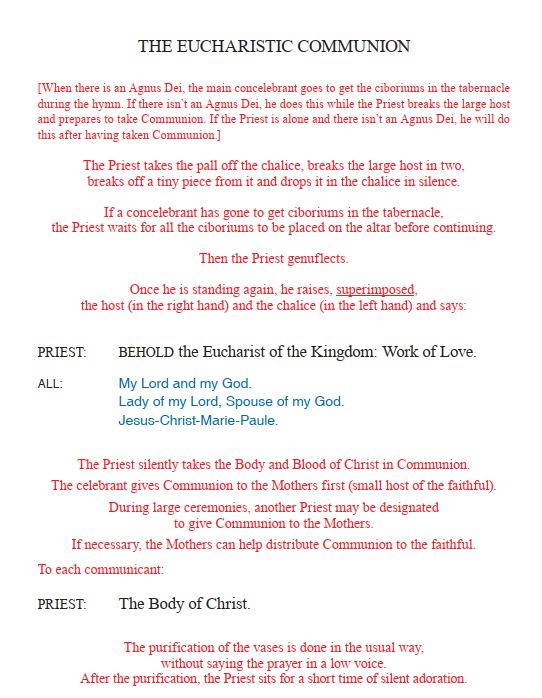
To get an impression of the changes, here is part 5 of the New Missal ”God as Son and God as Daughter” including the rites of Consecration and the Eucharistic Communion (Edition of 21 November 2024).