The Alternative Pope Project

The Alternative Pope Project

In 2015, I started the Alternative Pope Project. The goal was to identify and study individuals who, during the 20th and 21st centuries, claimed that they, and not the more well-known figure in Rome, were the true leader of the Catholic Church. To refer to them, I coined the term alternative popes.

I soon realized that it would be difficult to find sources about many of the claimants, as little material is found in research libraries. To solve the problem, I created this website. Initially, I wrote brief posts on the papal claimants I knew, asking for more information.

I was amazed by the feedback. Over the past almost ten years, several thousand people have contacted me.  Many have asked questions, wanting to know more, and many have helped me access source material or shared their experiences as (former) members of these groups. With their help, I have been able to amass considerable material, and I have been able to publish several more substantial texts that, in their turn, have led to new contacts and even more sources.

This project’s final outcome will be a sizeable monograph: Could the True Pope Please Stand Up: 20th and 21st-Century Alternative Popes. Hopefully, I will be able to finish it in 2026, thus ending a decade-long project.

To date, I have produced five monographs, five group profiles, and more than a dozen research reports listed below. I have also published ca. 50 blog posts, including brief studies on alternative popes and scanned sources.

Continue reading “The Alternative Pope Project”
Franz Engelhardt: The Fourth Seer of Fatima and Future Pope Peter II

Franz Engelhardt: The Fourth Seer of Fatima and Future Pope Peter II

Some compilations of twentieth-century alternative popes include a Julius Tischler, who asserted that he was Pope Peter II. Joachim Bouflet,who briefly described the case in his Faussaires de Dieu, is the only
researcher who offers some details. Bouflet stated that the claim was made in 1972, that Julius Tischler was a pseudonym, and that he was not a papal claimant in the strict sense but a claimant to a future papacy; he would be the last pope in history.

The person behind the pseudonym was Ferenc Egerszégi (1908–1982), a Hungarian Catholic priest who had lived in West Germany since the early 1960s. There, he officially changed his name to Franz Engelhardt. Apart from stating that he would be the pope of the End time, he made other far-reaching spiritual claims. He had been mystically present at Fatima in 1917, thus directly receiving the most known Marian apparitions of the twentieth century. Apart from the three Portuguese children, known to many Catholics, there was a “fourth seer”–himself. Unlike the other seers, Engelhardt received another, more important message from the Virgin in 1923. It was a continuation of the Fatima message and the starting point of his End time mission.

These claims are almost unknown today, even in apparitionist circles. If Franz Engelhardt is known at all today, it is probably as a sexual predator who was sentenced to prison for the abuse of minors. This
report will address Engelhardt’s background and apocalyptic teachings, as well as his life after the mystical claims in 1972.

New Book on Polish-American Pope Adam II

New Book on Polish-American Pope Adam II

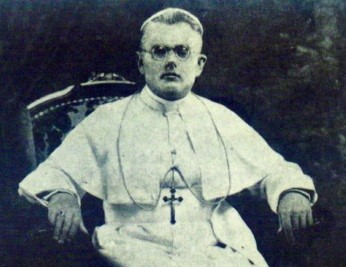
In 1927, a suspended Roman Catholic priest, Adam Anthony Oraczewski (1883‒1973), published a 60-page booklet in Kansas City, Missouri. It had a bold title: All in One True Faith. The front page features a photo of the author dressed in the papal white, declaring that as of August 7, he was Adam II, Pope of the Holy Catholic Church.

Oraczewski’s pamphlet scathingly criticized the Roman Catholic Church and proposed a drastic ecclesiastical reform that, according to the author, would lead to greater piety and human unity. The publication was the climax of fifteen years of conflicts between Oraczewski and Catholic church representatives in a long series of U.S. dioceses, parishes, and seminaries.

Among the twentieth-century alternative pontiffs we know of, Polish-American Adam II is one of the earliest and least known. In the book A Polish-American Pope:  Adam Oraczewski ‒ Adam II, I reconstruct Oraczewski’s biography by studying his own writings, newspaper articles, public records, and, not least, abundant files from ecclesiastical archives.

Oraczewski’s life story is very unusual and undoubtedly a part of the eccentric part of church history: an account of a pontiff in the periphery. It is a bewildering and tragic story, and it is worth telling.

A Polish-American Pope:  Adam Oraczewski ‒ Adam II is published as volume 19 in the ebook series Uppsala Studies in Church History and freely available here:

New Research Report on Valdir Ros – Pedro II: The Pope of Nova Iguaçu, Brazil

New Research Report on Valdir Ros – Pedro II: The Pope of Nova Iguaçu, Brazil

In 1968, Brazilian priest Valdir Ros (1942–1994) founded the Instituto Estrela Missionária (IEM; the Institute of the Missionary Star) in Urubici in his home diocese of Lages in the southern part of the country. It was an organization devoted to promoting mission among non-Christians and providing education for future missionaries. The same year, he moved to the diocese of Nova Iguaçu in the Baixada Fluminense, part of the Rio de Janeiro metropolitan era, where he also became a pastor of the impoverished parish of Riachão. The seminar was founded with the support of the diocesan bishop. Still, the IEM had an unclear canonical status for a long time, but in 1977, it received the status of a diocesan pious association (pia unio). However, that was nothing compared to Ros’ vision: to form a Latin American congregation that would contribute to world mission, not a group devoted to local parish work.

Though the relation had not been unproblematic before, in late 1979, an irreconcilable conflict grew between Valdir Ros and the bishop of Nova Iguaçu Adriano Hypólito OFM (1918–1996). There were several reasons: political,  religious, personal–and medical. In conversations, private letters, printed books, and pamphlets, Ros fiercely attacked the bishop, accusing him of being a Jew, a Communist, a Freemason–and a demon. When the conflict reached one of its many peaks in 1981, members of the IEM, too, regarded Ros as severely ill, and he was confined to a psychiatric clinic against his will. By this time, he was replaced as the parish priest in Riachão, and IEM soon left the diocese to move to another part of the country.

Continue reading “New Research Report on Valdir Ros – Pedro II: The Pope of Nova Iguaçu, Brazil”

New Research Report: Francis Schuckardt, the Papacy, and the Apocalypse

New Research Report: Francis Schuckardt, the Papacy, and the Apocalypse

Bishop Francis K. Schuckardt (1937–2006), founder and leader of the Fatima Crusaders, the Tridentine Latin Rite Catholic Church, also known as Tridentine Latin Rite Church (TLRC), and the Congregation of Mary Immaculate Queen of the Universe (CMRI), was an important figure in early U.S. Catholic traditionalism. Without a doubt, he was also one of the most controversial.

Schuckardt condemned the Second Vatican Council (1962–1965) and the post-conciliar developments in non-uncertain terms. Towards the end of the 1960s, he publicly declared Paul VI (sed. 1963–1978) an antipope and that the Holy See was vacant, the position that was later referred to as sedevacantism. Schuckardt founded a small religious community in Coeur d’Alene, Idaho, in 1967, which soon attracted larger groups of followers. In 1971, he was ordained a priest and consecrated a bishop by an independent Catholic prelate.

The group expanded from Idaho and moved its headquarters to Mount Saint Michael in Spokane, Washington state 1978. TLRC was the organization’s official name incorporated in Washington state, as they could not register as either the Catholic Church or the Roman Catholic Church, even if they asserted they were nothing less. Thus, they rarely used the name TLRC, and the adherents usually called their group the Mary Immaculate Queen of the Universe Community, of which the Fatima Crusade was the apostolate. In contrast, outsiders, especially after moving to Spokane, often called them the Tridentines.

Continue reading “New Research Report: Francis Schuckardt, the Papacy, and the Apocalypse”

Är påven katolik?

Är påven katolik?

Mitt syfte med boken Är påven katolik?: Traditionalistiska variationer på ett tema (Uppsala Studies in Church History, vol. 16; 80 sid) är att analysera olika traditionalistiska uppfattningar om huruvida de konciliära och post-konciliära påvarna–Johannes XXIII (1958–1963), Paulus VI (1963–1978), Johannes Paulus I (1978), Johannes Paulus II (1978–2005), Benedikt XVI (2015–2013) och Franciskus (2013–) verkligen varit sanna påvar eller om de har varit ledare för en ny icke-katolsk religion, av traditionalister ibland benämnd konciliereligionen, Novus Ordo-religionen, den vatikanska institutionen eller ”Kyrkan” inom citationstecken.

Det handlar i praktiken framförallt om diskussioner från mitten av 1960-talet till början av 1990-talet om huruvida Johannes XXIII och Paulus VI var motpåvar. För dem som hävdade att så var fallet var det självklart att även deras efterträdare var antipåvar.

Forskningen om merparten av de mer radikala traditionalistiska varianterna och deras syn på påven är begränsad och det finns, såvitt jag vet, ingen så bred och detaljerad översikt som denna på något språk.

Boken är tillgänglig i fulltext här:

White Smoke over Montana: Pius XIII and the true Catholic Church

White Smoke over Montana: Pius XIII and the true Catholic Church

Annuntio vobis Gaudium magnum. Habemus Papam. Reverdissimum Patrem Lucianum Pulvermacher, OFM Cap., Sanctae Catholicae Ecclesiae Presbyterem.

On October 24, 1998, white smoke appeared from the chimney of a small house in Montana. It was the signal that a new pope was elected. According to those present, the event ended a forty-year interregnum when the Catholic Church lacked a true leader. To them, there had been imposters on the Holy See ever since the death of Pope Pius XII in 1958.

The pope elected in Montana was the Capuchin priest Lucian Pulvermacher (1918–2009), who had left the ‘Novus Ordo church’ in 1976, becoming a sedevacantist. He took Pius XIII as his papal name, leading the true Catholic Church. Officially, ‘true’ should always be written in lowercase, as the Church Pius XIII led was nothing but the one Catholic Church, now in exile. Over fifty persons participated in the conclave. Apart from Pulvermacher, they were all laypeople, and most electors were not present but called or sent in their ballots.

For the research report

For a collection of papal documents, see

The Invisible Pope: Linus II and the 1994 Assisi Conclave

The Invisible Pope: Linus II and the 1994 Assisi Conclave

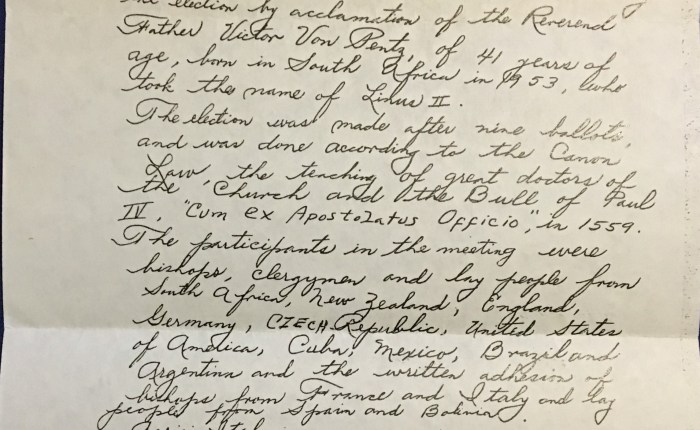
On June 29, 1994, a dozen people met in Assisi, Italy, to pursue a papal election, as they were convinced that John Paul II and his three predecessors were heretics and anti-popes and that the Holy See was vacant since Pius XII died in 1958. They held the theological position known as sedevacantism. As they claimed that no orthodox cardinals remained in the era of general apostasy, an ordinary conclave was out of the question. Still, the Holy See could not remain perpetually vacant, as St. Peter would always have successors until the end of time. Thus, they argued that it was lawful and, indeed, a duty for the faithful remnant–clergy, and laypeople–to restore the papacy and re-establish papal jurisdiction. This position is called conclavism. The participants in the Assisi conclave elected 41-year-old South African priest Victor Von Pentz (1953–2021), who took Linus II as his papal name.

See my research report:

Habemus Papam!: Michael II

Habemus Papam!: Michael II

On 29 July 2023, Archbishop Rogelio del Rosario Martinez Jr (b. 1970) was elected the successor of Pope Michael (David Bawden) and took Michael II as his papal name.

In February 2023, I wrote a substantial piece on Pope Michael for the World Religions and Spirituality Project. Pope Michael (David Bawden, 1959-2022) was elected in a small conclave in Kansas in 1990 and, for the last decade, based in Topeka. He claimed the papacy from his Vatican in Exile until his death on 2 August 2022.

From the time of his passing away, his group of adherents declared the Holy See vacant and began planning for a new conclave. Until recently, no date was fixed, but the group officially announced it in the June 2023 issue of the Olive Tree newsletter.

Continue reading “Habemus Papam!: Michael II”

Pope Tsietsi Makiti and the Gabola Church

Pope Tsietsi Makiti and the Gabola Church

The Alternative Pope Project I initiated in 2015 analyzes twentieth and twenty-first-century papal claimants. My focus is on persons who have claimed that they, not the vastly more recognized Roman pontiff, are the Catholic Church’s leader. For example, I don’t include the leaders of the Coptic Church, often called popes, as they do not claim to be successors of St. Peter. Neither do I include the Caodaist popes. Caodaism is a Vietnamese religion led by a pontiff and a college of cardinals. Though Catholic practices influence Caodaism, it is closer to Buddhist, Daoist, and Western Spiritist teachings.

Reformer Jean Calvin and Evangelist Billy Graham have sometimes more or less ironically been called the Protestant Pope, but of course, they did refer to themselves as such. However, leaders of a few groups of Protestant origin in the broadest sense of the word have declared themselves popes. One example is Guyanese Philbert London, televangelist and the leader of the Beacon Ministries and the House of Majesty, an independent Christian community influenced by prosperity theology. He claimed that God elected him pope and was publicly installed in 2016, taking Emanuel as his papal name. Another example is South African Tsietsi Makiti, leader of the Gabola Church.

Continue reading “Pope Tsietsi Makiti and the Gabola Church”