Images of the Celestial Messenger. Part 3.

Images of the Celestial Messenger. Part 3.

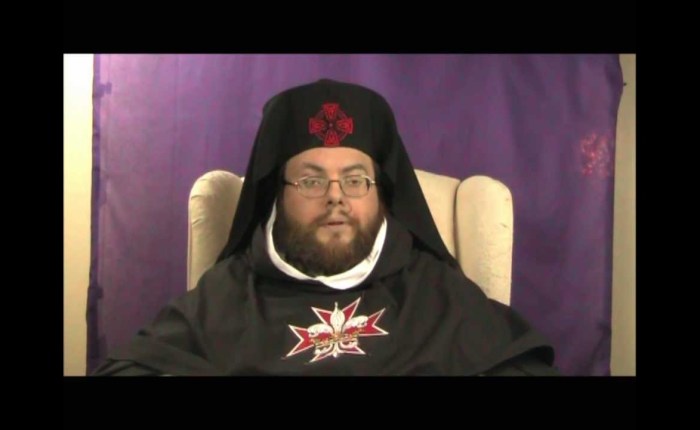
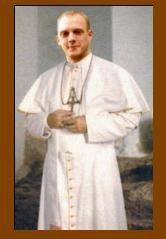
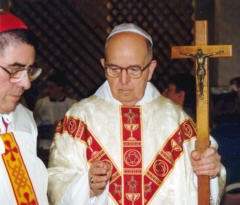
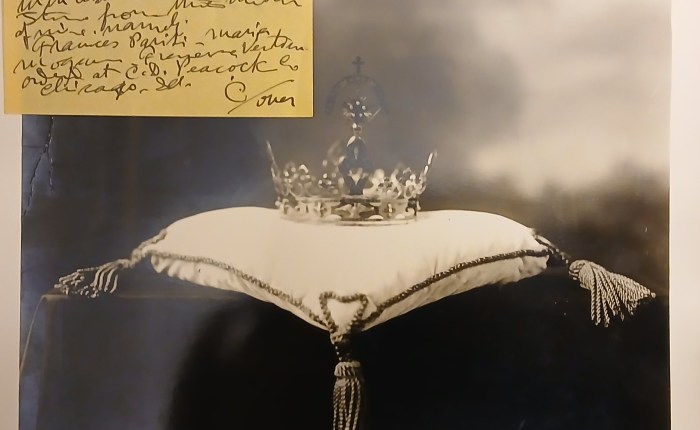
This post is the third part of my series of images of Giuseppe Maria Abbate (1886-1963), the Italian-American Celestial Messenger. They are part of my collection of documents related to Abbate and his Church. See part one and part two.

The focus of the New Jerusalem Church doctrine was Abbate’s claims of divine status and his role in salvation history. By the late 1910s, Abbate called himself Giuseppe Maria di Carmelo Abbate. When the Church was founded, he was referred to as Celestial Messenger (Messaggiero Celeste).

Later, his title became Padre Celeste. Still, he also referred to himself as the Universal Protector, St. Michael the Archangel, the Prince of Peace, God’s Vicar on Earth, and the Celestial King. Thus, Abbate claimed to be something of a combination of a pope, an archangel, a prophet, a king, and God incarnate.

Continue reading “Images of the Celestial Messenger. Part 3.”


Uppsala Studies in Church History

Uppsala Studies in Church History

In 2017, the Department of Theology at Uppsala University launched a new open-access book series, Uppsala Studies in Church History. To date (June 2025), we have published 20 volumes: ten in English and ten in Swedish. The titles focus on both Swedish and international themes.

Uppsala Studies in Church History is an e-book series published by the Department of Theology, Uppsala University. It includes both works in English and in Swedish. The volumes are available open-access and only published in digital form on http://www.diva-portal.org.

Uppsala Studies in Church History är en skriftserie som utges vid Teologiska institutionen, Uppsala universitet. Serien innehåller arbeten på såväl svenska som engelska. Skrifterna i serien är fritt tillgängliga och utges endast i digital form på http://www.diva-portal.org.

Click on the hyperlinks below to get access to the full texts.

Continue reading “Uppsala Studies in Church History”

Det excentriska är centralt

Det excentriska är centralt

Magnus Lundbergs installationsföreläsning som professor i kyrko- och missionsstudier vid Uppsala universitet, 15 november 2016.


Är detta inte själva sinnebilden av excentricitet? En engelsk gentleman i tredelad kostym som har kommit på idén att använda 17 meter exklusiv harristweed för att klä en häst på samma sätt. Här betecknar excentriskt det lätt bisarra, men acceptabla, som företrädesvis görs av brittiska män med gamla pengar. Det är kanske framförallt familjenamnet som skiljer excentrikern från byfånen. Personer–mänskliga eller icke-mänskliga–i tredelad kostym ska dock inte lägga beslag på ordet. Tweed är inget nödvändigt eller tillräckligt kriterium för excentricitet.

Continue reading “Det excentriska är centralt”

Modern Alternative Popes 21: Athanasius I

Modern Alternative Popes 21: Athanasius I

Bryan Richard Clayton (Athanasius I, 2011-?) was born in 1975 in Chicago. He worked as a policeman and a security guard and then briefly attended the sedevacantist CMRI seminary in Omaha, Nebraska. According to some sources, he thereafter received training from a traditionalist Franciscan in Mexico. Clayton was ordained a priest around 2005, and in 2007, he was consecrated by Bishop Patrick Taylor of the Society of the Virgin Mary, who resided in Buckley, West Virginia.

Continue reading “Modern Alternative Popes 21: Athanasius I”

Modern Alternative Popes 20: A Papal Hoax

Modern Alternative Popes 20: A Papal Hoax

 The Catholic Apostolic Remnant Church

This church with its alleged centre in Argentina is a complicated matter. Or not. The thing is that the church does not exist in reality. It is an internet hoax. The “church” has never been able to proof its existence despite claiming to have a large number of cardinals, bishops and priests, so it should be considered a hoax. Still, the Remnant Church has very active web pages, and the alleged pope publishes many formal documents. Consequently, it’s created by a person or a group with much knowledge of this type of traditionalist group. It is a well-constructed hoax.  According to the creators since 2006, three men have been pontiffs of the Catholic Apostolic Remnant Church.

Continue reading “Modern Alternative Popes 20: A Papal Hoax”

Modern Alternative Popes 19: The Catholic and Mercedarian Church

Modern Alternative Popes 19: The Catholic and Mercedarian Church

Joaquín Llorens Grau (Alexander IX, 2005-). According to the group’s own information, a traditionalist missionary in Guatemala, Antonio Velasco founded the Congregación Mercedaria Sagrada Tradición Nuestra Señora de la Merced, Generala de los Ejércitos Celestiales, Corredentora. They claim that Velasco was consecrated by Bishop Moises Carmona of the Unión Católica Trento, who was in his turn was consecrated by Archbishop Thuc. There is, however, no independent support for this assertion. Together with six priests and nine novices, Velasco transferred to Elche (Elx) in Spanish Alicante.

Continue reading “Modern Alternative Popes 19: The Catholic and Mercedarian Church”

Modern Alternative Popes 15: The Cardinal Siri Thesis

Modern Alternative Popes 15: The Cardinal Siri Thesis

On 26 October 1958, white smoke coming out from the famous Vatican chimney for five minutes indicated that a new pope had been elected after the demise of Pius XII. Somewhat later, however, this was reported a mistake; the conclave went on. The advocates of the so-called Siri Thesis mean that Guiseppe Cardinal Siri, the archbishop of Genoa, was legally elected at the conclave, and not the Patriarch of Venice, Angelo Roncalli (John XXIII).

Continue reading “Modern Alternative Popes 15: The Cardinal Siri Thesis”