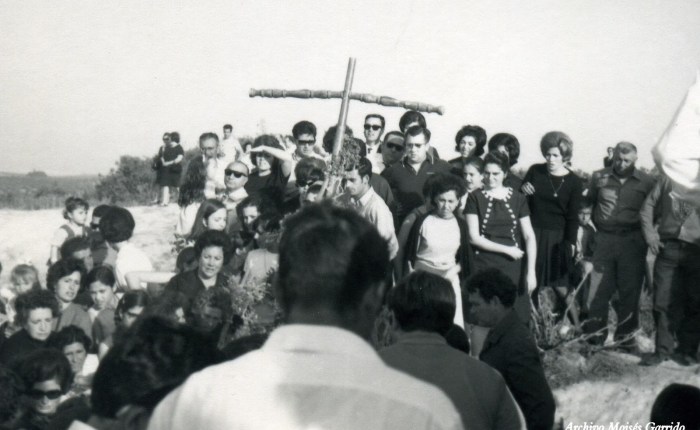
Palmar de Troya, located about 40 kilometers south of Seville, close to Utrera, was settled in the 1930s. By the late 1960s, the town had about 2,000 inhabitants, most having relocated from other parts of Spain. The majority of them were day laborers on big agricultural estates, latifundios. Anne Cadoret-Abeles, who conducted anthropological fieldwork there in the late 1960s and early 1970s, noted the lack of communitarian spirit resulting from virtually all inhabitants being newcomers. The town had electricity but still lacked a medical doctor and running water, and its school remained undeveloped.
Month: May 2016
Palmarian Rituals
Sacraments
Just as the Roman Catholic church, the Palmarians hold that Christ instituted seven sacraments. Nevertheless, they also teach that in this end-time the election to the papacy is an eighth, invisible sacrament, directly conferred by Christ (TM, chapter 34, volume 78-80).
The Palmarians have an exclusive soteriology; it is only possible to reach salvation within the visible Palmarian Church in union with the pope, where all divine graces are distributed since the end of the Roman era of the church. At present, the One, Holy, Catholic, Apostolic, Palmarian church is the mystical body of Christ and the Virgin. Therefore, the sacraments of other churches, including the Roman Catholic have no value whatsoever, as the Holy Spirit does not work through them. Thus, they are empty rituals and, in fact, sacrileges that bring damnation on those who administer and receive them.
Palmarian Doctrines, Part III
Josephology
Just as there is a parallelism between Christ and the Virgin in Palmarian theology, there is also a clear parallelism between the Virgin and St. Joseph. Nevertheless, Joseph is subordinated to the Virgin, as she is subordinated to Christ. The Palmarian Josephology is in no way as detailed as its Mariology, but still substantial and detailed, and has a prominent place in its Credo. In one of the first papal documents, promulgated in 1978, it was taught that Joseph was pre-sanctified in the womb of his mother in the third month of his conception. From that time, he was freed from the stain of original sin. Thus, he was born without the ability to commit any sin during his entire existence. Just as the Virgin, he did not have to suffer, as suffering was the effect of the fall, but to help humanity, he chose to do it anyway (CP; DP 3).
Palmarian Doctrines, Part II
Mariology
If the Roman Catholic Church has made few infallible dogmatic pronouncements, the Palmarian popes have made hundreds, if not thousands. During his first days as the pontiff, Gregory XVII promulgated a series of new Marian dogmas. Many of them had been discussed in the Roman Catholic Church for centuries. In the Early Church, it was taught that the Mary was a (perpetual) virgin and the mother of God (theotokos). Thereafter, it would take a long time before the church made any other binding dogma on the Virgin. In 1854, the Holy See announced a new dogma, the Immaculate Conception, that the Virgin Mary was conceived without the stain of original sin. Finally, in 1950, Pius XII infallibly dogmatized the Assumption of the Virgin: that Mary at her dormition (she did not die) was brought to heaven in body and soul (For a summary on Mariology, see Pelikan 1996; for details, see Marienlexikon 1988-1994).
Palmarian Doctrines, Part I
Doctrinal Texts
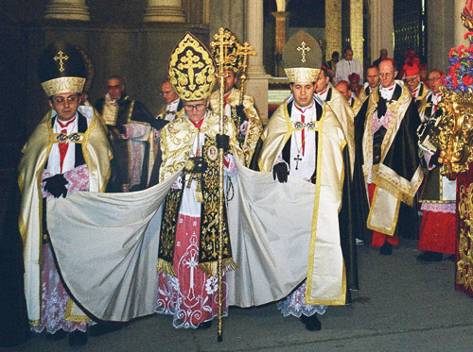
From its foundation in 1978, the Palmarian Church has been very text centered. It has published many documents that can serve as sources for a study of their theology. However, because of the increasingly closed nature of the church, it is not easy to get access to the texts and very little is found in research libraries. They have to be acquired in other, sometimes, complicated ways. Palmarian documents have often been published in parallel English, Spanish and German versions, but there are translations into French, Portuguese, Polish and Italian as well. They give evidence of a successive doctrinal development from a rather typical, though clearly apocalyptically-centered Catholic traditionalism, to a very different belief system.
The Palmarian Church in the 21st Century, Part II
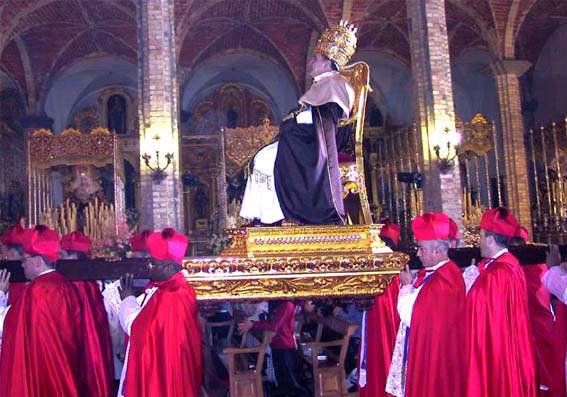
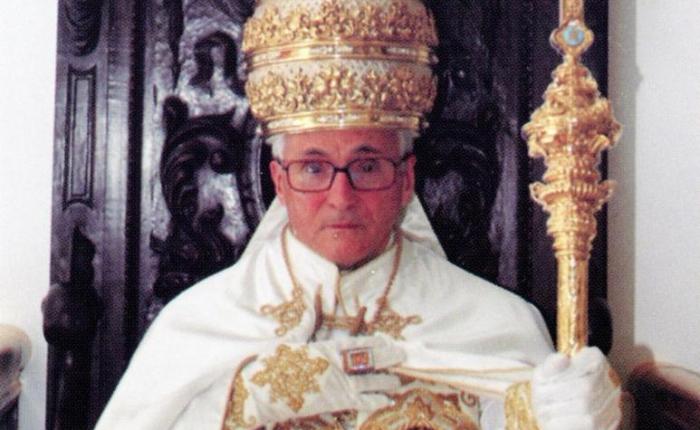
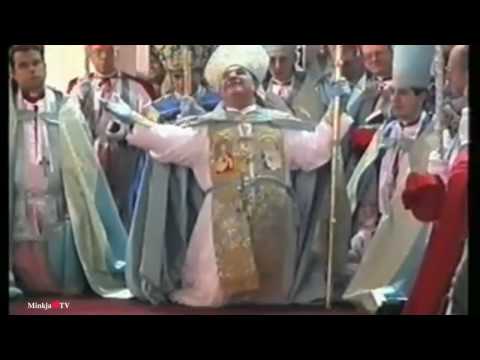
Holy Week in 2005 was a crucial time in the history of the Palmarian Church, as Gregory XVII died on March 21. In later years, he had become increasingly invisible in the life of the church and only appeared in Palmar de Troya on very special religious festivities, being carried in his gestatorial chair, tiara, miter or white biretta on his head. At his death, there was no conclave as he had already named Father Isidoro María his successor. The latter was crowned on March 24, taking Peter II as his papal name (ABC March 23, 24, 27, 2005). It is not known whether he regarded himself as Petrus Romanus, the last pope in the history, according to the prophecies of St. Malachy.
Continue reading “The Palmarian Church in the 21st Century, Part II”
The Palmarian Church in the 21st Century, Part I
The late 1990s and early 2000s was a very turbulent time in the Palmarian church, filled with secessions and expulsions. The crisis had to do not only with the new teachings of the church, but also with the behavior of the pope and other leaders. In a 1998 sermon, Pope Gregory XVII commented on the situation, claiming that the group of true believers would be even smaller in the near future
Continue reading “The Palmarian Church in the 21st Century, Part I”
Media Coverage of the Changes in the Palmarian Church
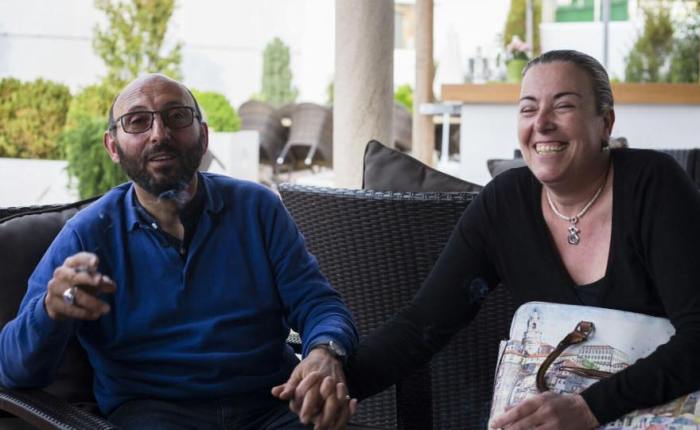
Since news about the 22 of April escape of Pope Gregory XVII from Palmar de Troya was made public by me and others, there have been many articles about the matter in the Spanish press. The combination of a hermetically closed religious group and a pope leaving to live with his girlfriend, claiming that he does not believe in the church teachings anymore is of course thrilling to many, including me.
Below you will find links to some articles from late April and early May that are quite interesting and not too speculative, including several interviews with the ex-pope, who now wants to “turn the page”and leave everything behind him, presenting the Palmarian church as a “set up” (montaje). One month after the departure of Gregory XVII, several Spanish TV channels have broadcast longer documentaries about the history of the Palmarians and the current events.
Early news on the escape of Pope Gregory XVII, ABC Sevilla 25 April 2016: El «papa» de El Palmar de Troya pierde su fe y deja su «orden» sin despedirse de sus seguidores
A history of the Palmarian history and the recent events, including the coronation of the new pope, Peter III, ABC Sevilla 26 April: Los cuatro «papas» del Palmar de Troya
Continue reading “Media Coverage of the Changes in the Palmarian Church”